| |
| |
 |
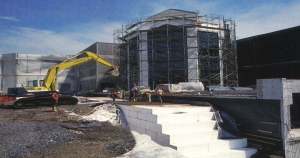 |
EPS Geofoam
“EPS Geofoam” describes low-density cellular plastic foam
solids used in geotechnical applications such as lightweight
fill for construction on soft ground, for slope
stabilization, and retaining wall or abutment backfill; as
well as for roadway and runway sub grade insulation and
foundation insulation. |
| |
Doing More with Less
The philosophy of “less is more” has permeated almost every
facet of modern life – construction engineering
notwithstanding. EPS geofoam is a perfect fit, giving
designers a unique product that works in conjunction with
other, more traditional materials to solve construction
problems with unprecedented strength and flexibility.
EPS geofoam enables engineers, architects, builders and
other industry professionals to design by function, that is,
to focus on the key geosynthetic functions they’re looking
for in an particular project, then select the best
combination of products to achieve the goals most cost
efficient.
EPS geofoam provides several unique functions not available
with other types of geosynthetic materials. This
multi-functionality replaces the need for many different
products to achieve the desired results, making EPS geofoam
highly cost effective.
At the same time, EPS geofoam products work very well as a
complementary resource, with EPS geofoam-based composites
and new synergies enabling end users to design with even
greater flexibility and more options, not to mention unique
results that would not be otherwise attainable.
EPS geofoam products help reduce and absorb the impacts of
naturally occurring forces such as gravity and earthquakes
rather than trying to strengthen or stiffen a structure to
resist the forces. By working with, rather than against
these forces, EPS geofoam gives engineers more flexible
solutions to construction challenges.
Inside Geofoam
The two key properties that make EPS geofoam so attractive
in design and construction are its low density for stress
and deformation-related construction problems, and its
thermal insulation properties that help combat frost-heave
problems.
The density of EPS geofoam is controlled during the
manufacturing process, and ranges from 15 to 22 kg/m3 for
lightweight fill applications. This low density is only
about 1 to 2% of the density of soil and rock, making EPS
geofoam a superior, ultra lightweight fill material that
significantly reduces the stress on underlying subgrades.
The lighter load reduces settlements and boosts stability
against bearing and slope failures.
Because it is approximately 98% to 99% air by volume,
geofoam is a very efficient thermal insulator. EPS geofoam
can be produced with higher densities to obtain the higher
R-values preferred for insulation purposes, as well as to
achieve lower deformation. EPS geofoam has been used in road
and airfield pavements and railway track systems, beneath
refrigerated storage buildings, sports arenas and storage
tanks to prevent ground freezing and heaving, and in
below-ground building segments to reduce seasonal heating
and cooling requirements.
Other notable geofoam properties
include:
• High compressive strength – makes EPS geofoam durable and
resistant to damage.
• Low moisture absorption – moisture absorption rates
increase as density increases, but are still minimal.
• Low interface friction – in direct shear tests, the
interface friction between sand and EPS geofoam is
comparable to the internal friction of sand alone. |
| |
 |
 |
Road
Embankments
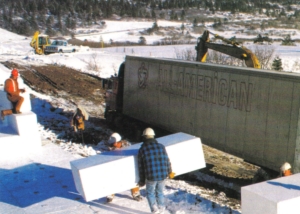
Geotechnical engineers have long recognized the usefulness
of lightweight fill to reduce load strain. Traditional
lightweight materials used in embankment construction
include chipped bark, sawdust, dried peat, fly ash, slag,
cinders, cellular concrete, lightweight aggregates, shredded
tires, and seashells. A major advantage of using geofoam as
fill material in embankments is that it is up to 50 times
less massive than other lightweight fills, thus providing: |
| |
• Maximum available right-of-way
• Faster construction schedule
• Lower traffic impact |
• Comparatively clean construction
near water
• Reduced labor
• Minimal future maintenance |
| |
Retaining Wall or Abutment Backfill
Placing EPS geofoam behind retaining structures and
below-grade walls reduces lateral pressure, lowers
settlements, improves waterproofing and provides better
insulation. The low density and relatively high
compressibility of EPS geofoam also limit horizontal forces
against retaining structures during earthquakes.
Slope Stabilization
Because the density of EPS geofoam is 50 to 100 times lower
than soils, geofoam is highly effective in improving the
stability and safety of slope construction by minimizing the
potential of failure surfaces between driving blocks and
resisting blocks in a slope.
Pavement Insulation
EPS geofoam is used successfully as highway and airport
pavement sub grade insulation to reduce sub grade stress and
deformation as well as to protect against frost heaving.
Frost Protected Shallow Foundations
In cold climate regions, building foundations are required
to extend below depths of expected frost penetration. This
typically requires housing construction with basements or
crawl space below floor grade. By using EPS geofoam, homes
can be built in cold climates with slab-on-grade support.
Frost protected shallow foundations significantly reduce
construction costs as well as energy costs. |
| |
| For more
information regarding EPS Geofoam please use links provided
below: |
Geofoam Technical Bulletin
Federal Highway Administration: EPS
Geofoam Construction
Federal Highway
Administration: Geotech Resource Center |
| |
|
|
|
|
